
Research Domain
Comprehensive overview of our research background, objectives, and methodology
Literature Survey
Artificial Intelligence (AI) has transformed criminal investigations from traditional, manual processes into data-driven methodologies. Early rule-based systems in policing demonstrated AI's ability to detect criminal patterns and enhance decision-making [1], [6]. Later studies by Singh and Patel analyzed 120 articles and confirmed a significant expansion of AI use in crime forecasting across 34 crime types [7].
Predictive policing remains a major application, enabling proactive law enforcement through crime forecasting [8]. Yet, real-world implementations like Chicago's SSL system revealed algorithmic bias and transparency issues, leading to its deactivation [6], [9].
Behavioral analysis and interrogation technologies have evolved from subjective observation to multimodal analysis combining facial, speech, and physiological data. While early Behavioral Analysis Interviews showed limitations [10], CNN-based frameworks achieved accuracies up to 98.6% in emotion detection [11]. Multimodal integration using eye-tracking and LLM inference offers deeper insights and redundancy when one modality fails [10].
Speech Emotion Recognition (SER) now assists lie detection and behavioral profiling through CNN-BiLSTM models with 72% validation accuracy, though stability issues across languages persist [12], [13]. Similarly, NLP applications in legal documents employ Named Entity Recognition and Legal-BERT to summarize and classify text efficiently, though annotated datasets and domain bias remain challenges [5], [12].
Multimodal fusion further enhances behavioral analytics but introduces synchronization and data-quality challenges [9], [14]. Ethical and privacy concerns are critical, as bias in AI systems risks discriminatory outcomes [15].
Research gaps persist due to limited integration of end-to-end AI systems and inconsistent performance measures [15], [16]. Recent surveys stress the need for unified architectures integrating NLP, behavioral analysis, and pattern recognition [6], [8].
Future directions include explainable and human-in-the-loop AI to maintain investigator control, emphasizing fairness, accountability, and legality in next-generation investigative platforms.
References
[1] R. Choudhary, AI in Criminal Investigations: From Automation to Predictive Analytics, Forensic Science Int, 2022.
[2] S. Liu and J. Miller, Challenges in Multilingual Legal Document Processing, J.Law & Tech., 2021.
[3] K. Robinson, "Predictive Policing and AI in Law Enforcement: A Systematic Review," Policing & Society, Vols. vol. 31, no. 5, pp. 567-583, 2021.
[4] H. Kim, LAPIS: Language Model-Augmented Police Investigation System, arXiv preprint arXiv:2401.12345, 2024.
[5] A. Maheshwari, AI for Legal Document Review: Comparative Analysis of Current Platforms, ACM Legal Tech Conf, 2020.
[6] N. Dunsin, AI and ML in Digital Forensics and Incident Response, Forensic Comput. Sci., 2022.
[7] J. Singh and P. Patel, Multimodal AI in Forensic Applications: A Scoping Review, Front. AI, 2022.
[8] M. Gonzalez, "OCR in Legal and Forensic Domains: Pitfalls and Advances," IEEE Access, vol. vol. 9, p. pp. 145320–145333, 2021.
[9] P. Brown, Evaluation of Large Language Models for Legal Tasks, Proc. NeurIPS Workshop on Law & AI, 2023.
[10] L. Roberts, AI Interview Tools in HR and Qualitative Research, J. Appl. Psychol. Tech., 2022.
[11] B. Carter, Static Question Banks vs. Dynamic Interviewing with AI, Comput. Soc. Sci. Rev., 2021.
[12] K. Verma, "Multimodal Stress Detection Using FER, SER, and HRV," IEEE Trans. Biomed. Eng., Vols. vol. 68, no. 11, p. pp. 3421–3432, 2021.
[13] AERA, APA, and NCME, Standards for Educational and Psychological Testing., Washington, DC: AERA, 2014.
[14] D. Richardson, Bias and Accountability in AI Criminal Justice Systems, Ethics & Info. Tech., 2022.
[15] M. Johansson, Behavioral Profiling and Multimodal Fusion in Forensic Science, Forensic Psychol. Int., 2023.
[16] Y. Z. a. F. Lin, Reinforcement Learning for Social Interaction Analysis, IEEE Trans. Affect. Comput., 2021.
Research Gap
Automated Data Collection and Structuring
Most existing systems in law enforcement rely on manual entry or limited OCR tools for processing police reports and court documents. Current literature lacks robust multilingual document-processing pipelines.
Dynamic Question Generation and Response Analysis
Research into adaptive AI-driven interrogation support remains scarce. Prior systems use static question banks that fail to adjust based on context or prior responses.
Multimodal Behavioral and Physiological Analysis
Integration of multiple synchronized behavioral and physiological stress indicators for field-grade multimodal analysis is still limited. Existing studies seldom fuse multiple signal types with synchronization.
Incident Correlation and Pattern Identification
Current AI models for crime prediction typically operate on historical crime datasets without linking narrative testimonies or cross-case context.
Research Problem
Criminal investigations in Sri Lanka remain largely manual, with fragmented records, subjective judgments, and limited data integration. Investigators struggle to process unstructured, multilingual reports and correlate related cases, leading to delays and inconsistencies. Traditional interrogation methods also lack objective tools to assess stress or credibility, increasing bias risks.
Research Objectives
Automated Data Collection and Extraction
Develop a system capable of extracting and structuring information from unstructured legal documents in Sinhala and English.
Dynamic Question Generation and Response Analysis
Create an adaptive interrogation support module that generates context-aware questions using LLMs and reinforcement learning.
Multimodal Behavioral and Physiological Analysis
Integrate facial, vocal, and physiological signal analysis to assess emotional state and credibility during interrogations.
Incident Correlation and Pattern Identification
Implement ML models that correlate new incidents with historical cases using structured attributes and unstructured narratives.
Visualization and Web Application
Design a web-based dashboard consolidating all system outputs into a unified interface for investigators.
Methodology
The proposed AI-augmented criminal investigation system mainly can be divided among four main components/phases.
1. The Automated Data Collection and Management phase.
2. Dynamic Question Generation and Response Analysis phase.
3. Multimodal Behavioral and Physiological Analysis phase.
4. Incident Correlation and Pattern Identification phase.
It combines automated data extraction, adaptive questioning, behavioral analysis, and predictive correlation to provide an integrated platform that enhances the efficiency of investigation as well as its accuracy.
The overall system diagram presents the workflow of the proposed platform:
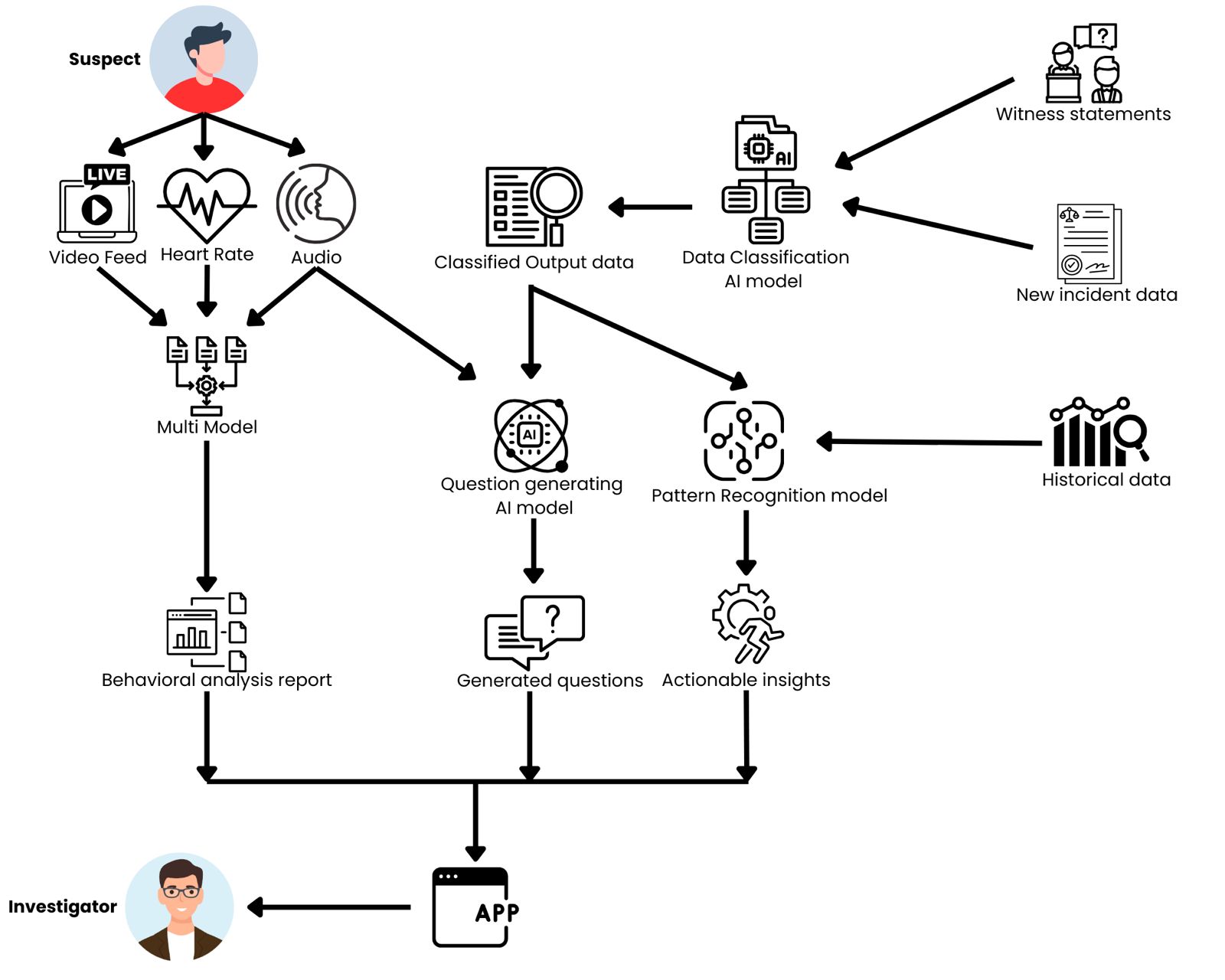
At its center is the suspect, who acts as the hub of multimodal data acquisition. Inputs are gathered through three key channels: video streams for facial expression analysis, heart rate signals for physiological stress detection, and audio for speech emotion recognition and content extraction. These streams are processed by a multimodal fusion processor that combines them to create comprehensive behavioral analysis reports. This fusion provides more accurate stress evaluations than any single modality alone. Alongside these behavioral signals, the system integrates structured and unstructured inputs such as witness statements, new incident reports, and historical case data into an enhanced classification model.
Two AI components drive the investigative workflow: the Question Generation Model, which produces interrogation questions based on case data and investigator feedback, and the Pattern Recognition Model, which identifies correlations and generates insights from prior cases. All system outputs including behavioral dashboards, dynamically created questions, and pattern-based findings are consolidated into a single investigator interface that ensures real-time decision support while maintaining investigator control.
Technologies Used
Frontend


Backend



AI/ML



NLP



Computer Vision


Database